Transforming Lives
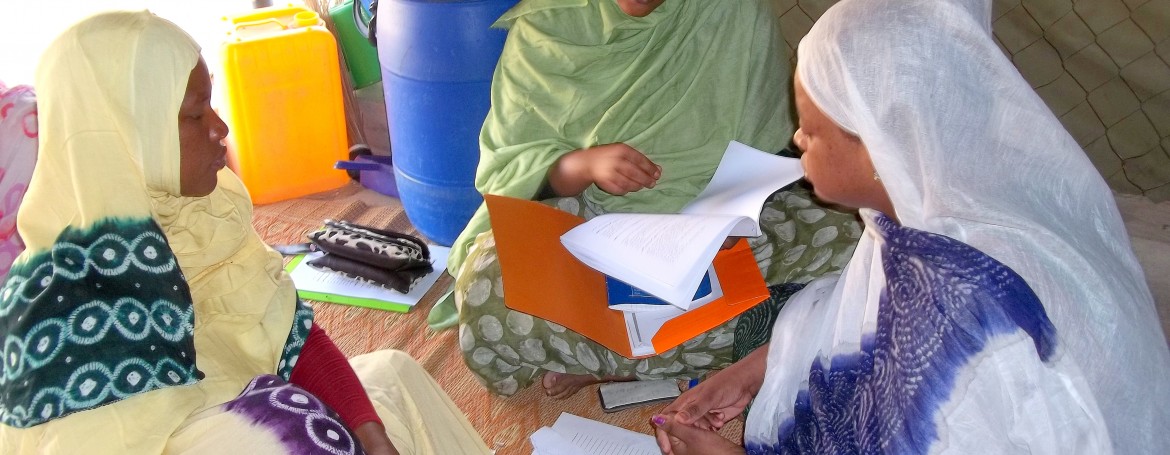
Background: In January 2009 Doulos Community began to interview each of the women’s groups at the Arafat Zone 4 and Arafat Zone 5 centres. Our objective was to assess how well the groups were functioning after 2-3 years, and research each group’s strategy and degree of success in managing group finances. The following is one group’s story. (The group was picked at random.)
There are 20 women who are members of Group 10 at the Arafat Zone 4 CDC. In June 2006, the group was selected to participate in the community garden program at the Arafat zone 4 and zone 5 CDCs. Each woman contributed 600 ouguiyas (approx $2.50 at exchange rate $1 = 240 UM) as her initial “dues,” for a total of 12,000 UM ($50).
The first four months of participation in the gardening program for group 10 were difficult due to irregular water availability. Many of the first plants died. Au Secours (Doulos’ local NGO partner who manages the daily activities of the Arafat CDCs) and the women of Group 10 worked together to find a solution and chose to construct a water cistern (M’balka) using the 12,000 UM contributed by the group women to cover a significant portion of the construction costs.
Once the water supply problem was solved, the garden began to thrive. At least four different varieties of vegetables and plants were sown in the garden: okra, eggplant, tomatoes and mint. Each woman was responsible for four plants, for a total of 80 plants cared for by Group 10. The vegetables produced by these 80 plants were sold over an 8 month period. All sales were recorded in the group’s register. By the end of June 2007, when the group’s participation in the garden program ended, the group had collected a total of 60,000 UM ($250) from the sale of the vegetables, with all the proceeds being pooled in the group’s shared fund (“caisse”).
Beginning in July 2007, the women of Group 10 launched a revolving loan fund using the 60,000 UM in their group caisse. Three women in the group were selected as initial loan recipients, with each woman receiving a 20,000 UM loan. Typically the women used the money to purchase malafas (the wraps or veils worn by Moor women) or cosmetics and beauty products for resale. Each woman was given 2 – 3 months to repay the loan. Over and above the loan repayment, each woman’s profits were divided into two portions, one portion the women kept for themselves. Another portion was used towards creating a special group “emergency fund” to help women in the group cover unforeseen large expenses, such as medical needs. Decisions about how such emergency funds are distributed and repaid are made on a case by case basis by group’s leadership committee.
As of the date of the group interview on 3 February 2009, 19 of the 20 members of Group 10 had benefited from one of the group’s revolving loans. The portion of profits from group activities contributed to the group caisse over this 20 month period totalled 97,415 UM ($406) over and above the 60,000 UM revolving loan fund, giving the group caisse a total of 157,415 ($656) – a gain of 160%, not counting the portion of the profits which the women kept for themselves.
It should be noted that group has managed its finances and activities completely independently since July 2007. The leadership committee of Group 10 continues to meet with Au Secours and Doulos staff from time to time to discuss the CDC programme and the needs of the community, but the group is not dependent upon help from either Au Secours or Doulos in managing its funds or business activities, which gives us great hope for the sustainability of the CDC program. Doulos and Au Secours helped provide a starting point , mobilizing and organizing women into groups who then participated together in various shared activities, including literacy classes, a community hygiene and environmental awareness program, and the community garden. The trust and confidence gained through these shared activities has proved an invaluable foundation for the continued success of the group in managing the group caisse and developing their small business skills, allowing them to pool their profits and strengthen community resilience.
The women of Group 10 are eager to expand their business skills and seek further training in sewing and cloth-dying so that they can continue to multiply their group’s funds. Doulos and Au Secours will be looking for opportunities to further support the women of Group 10 and help them and the other groups in zones 4 and 5 build businesses that can succeed for the long-term.
Orange and Yellow
Donkey Carts: what an inspiring image! A small brownish-gray animal, harnessed to a wheeled platform of planks and corner-iron… Well, maybe not so inspiring, but essential if you live in the African Sahel where donkey carts are the main form of transportation for subsistence farmers
 |
 |
Doulos’ project in the Guidimagha has been distributing materials to small farmers on credit for the past 4 years. Donkey carts have always been in high demand. Doulos focuses on the poorest sectors of the population and has been using donkey carts made from recycled car parts, but the villagers that we serve have been concerned that the carts that we supply aren’t rugged enough for the rocky and steep terrain of our region. After all, there are no paved roads in the whole region of Guidimagha, and the terrain is crisscrossed with dry riverbeds and rocky hills. Tough terrain for donkey carts!
The icon of quality in our area is the Senegalese donkey cart. With its imported axel and heavy welded bed, it can take a lot of pounding, and all the Senegalese carts are painted bright yellow so that they stand out from the competition. Of course lots of local welders now paint their donkey carts yellow too in imitation of the better quality carts. We have hesitated to distribute these donkey carts because their expensive price (about $400) strains the means of the poor farmers that we serve. However, it has become clear that our recycled blue carts built for the paved roads of the capital city won’t take the beating from running on poor dirt tracks in the Guidimagha.
This year Doulos technical staff have worked hard with local welders and with suppliers in the capital city to come up with a solution that will help all parties in the region. We have ordered a supply of imported axles through an agricultural supply house in the capital. Farmers in our region tell us that the “stick” (the axel) is everything! That is, the main thing that makes a cart durable is a high quality axel. This February, we took our first shipment of axels here in Sélibaby and ordered 20 high quality carts that followed the essentials of the Senegalese designs, but manufactured locally.
It has been great to get the local welders involved, and they are really proud of the product that they are producing. In addition, we have been able to cut the cost of manufacture down to about half of what we might have had to pay for the Senegalese carts. The only question left was what color to paint the Doulos carts so that we could identify our product easily. We decided on orange paint since we had never seen anyone use orange paint on donkey carts. We wanted our carts to stand out from the rest.
The first twenty went out immediately, and the new orange carts have been the talk of the town. We are very pleased with the quality and with this opportunity to work with local tradesmen. In addition, we have been able to recommend our axel supplier to local welders. It looks like they will be producing a lot of quality carts for sale locally in the near future. And, in the villages, people like the Diawo family will be able to cart their water back from the well 3.5 kilometers from home. The women’s co-op in Salkha can now organize regular visits to the market 7 kilometers away in Ould Yenjé where they can sell their produce and purchase essentials for their families. In the past each woman would leave early in the morning, carrying her produce in on her head, and return in the evening. Now four or five women can ride together and return with sacks of grain, sugar and milk.
We feel that the new Donkey carts have been very beneficial for the region, and that the people have really appreciated them, but there is one problem. Several of the local welders have suddenly decided to start painting their donkey carts with orange paint. I wonder where they got that idea?
Garden in the Desert
Since the beginning of FY04, DoulosCommunity has partnered with a local NGO partner, “Au Secours”, to run two Community Development Centers in the Arafat district of Nouakchott. While incorporating aspects of Doulos’ traditional Maternal and Child Health program activities, these centers also incorporate broader development activities including literacy classes and sewing groups.

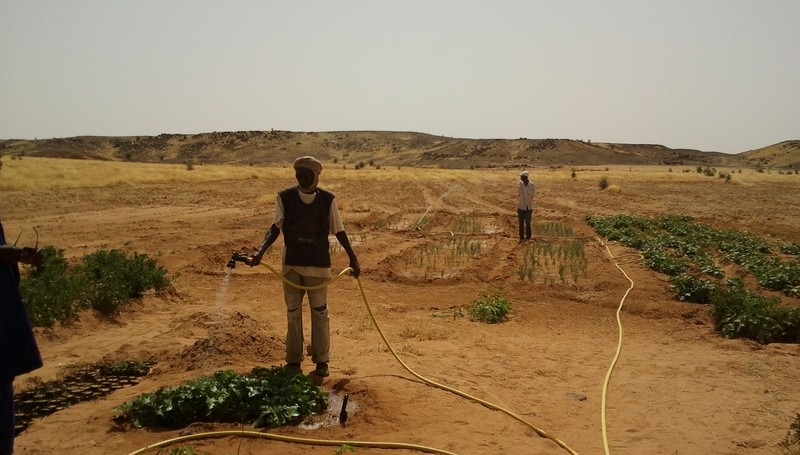
In FY05 those additional activities were expanded to include a community garden. The garden was the dream of several of the women leaders at the centers. They approached NGO partner Au Secours who helped negotiate with a local school regarding a vacant plot of land on which to plant the garden. With the promise of the land in hand, the women’s leaders and Au Secours came and shared their dream of a garden with Doulos staff. Doulos was able to secure the partnership of colleagues in a small international NGO working in agriculture and gardening who were able to provide training and appropriate technology (drip irrigation kits and netting) to the women.
The garden was a huge success in the community, involving nearly 300 women from the two community development centers. Each time Doulos staff would visit, women would excitedly show off the latest progress and produce. Even more exciting than the successful harvest of vegetables, however, was the community spirit that the project engendered. Two years’ previously, these women shared how they hadn’t known one another, hadn’t interacted with their neighbors. Now, through the activities at the Community Development Centers, they had made friends and learned new skills. They were busy brainstorming about how to pool the profits from the garden for the good of their community: perhaps setting up a community store where cooperative members could buy staples at a reduced price, or establishing some kind of day-care system for their children which would free women to go to the markets and sell their vegetables or the traditional veils they had sewn and dyed.
In a rapidly changing and expanding city such as Nouakchott, where new neighborhoods are springing up in the middle of nowhere, and traditional social networks often weakened, the success of these two pilot community development centers offers exciting evidence of the potential for helping women and families build relationships with their neighbors and in so doing, multiplying the knowledge and Links available to each to improve their families’ health, and livelihood. The MCH program begun by Doulos and Au Secours provided the opportunity and the motivation the women needed to band together in cooperatives. The women and families themselves provided the ideas, energy and commitment to seize the opportunity and strengthen the well-being of their Nouakchott neighborhood. |